The History of the Eucharistic Rosary Congress
The Eucharistic Rosary Congress was born in Poland in 1979, at a pivotal moment in the history of both the Church and the world. Poland was still under Communist rule, and Pope St. John Paul II, newly elected to the Chair of St. Peter, desired to return to his homeland. The Communist government, however, resisted his visit, fearing the spiritual renewal it would inspire.
Moved by an inspiration received in prayer, the faithful gathered at the National Shrine of Our Lady of Częstochowa at Jasna Góra for seven days and seven nights of continuous Eucharistic Adoration, praying the Holy Rosary at the beginning of every hour before the Blessed Sacrament. Their intention was simple but profound: to entrust Poland, the Church, and the Holy Father’s pilgrimage to Jesus through the intercession of the Blessed Virgin Mary.
On the seventh and final day, the Communist government unexpectedly granted permission for Pope John Paul II to visit Poland. His pilgrimage rekindled the faith of millions and became one of the great turning points in modern history, inspiring the Solidarity movement and contributing to the eventual collapse of Communism throughout Eastern Europe. For those who organized the first Rosary Congress, this was a powerful witness to the fruits of united prayer before the Blessed Sacrament.
Inspired by the Dream of St. John Bosco
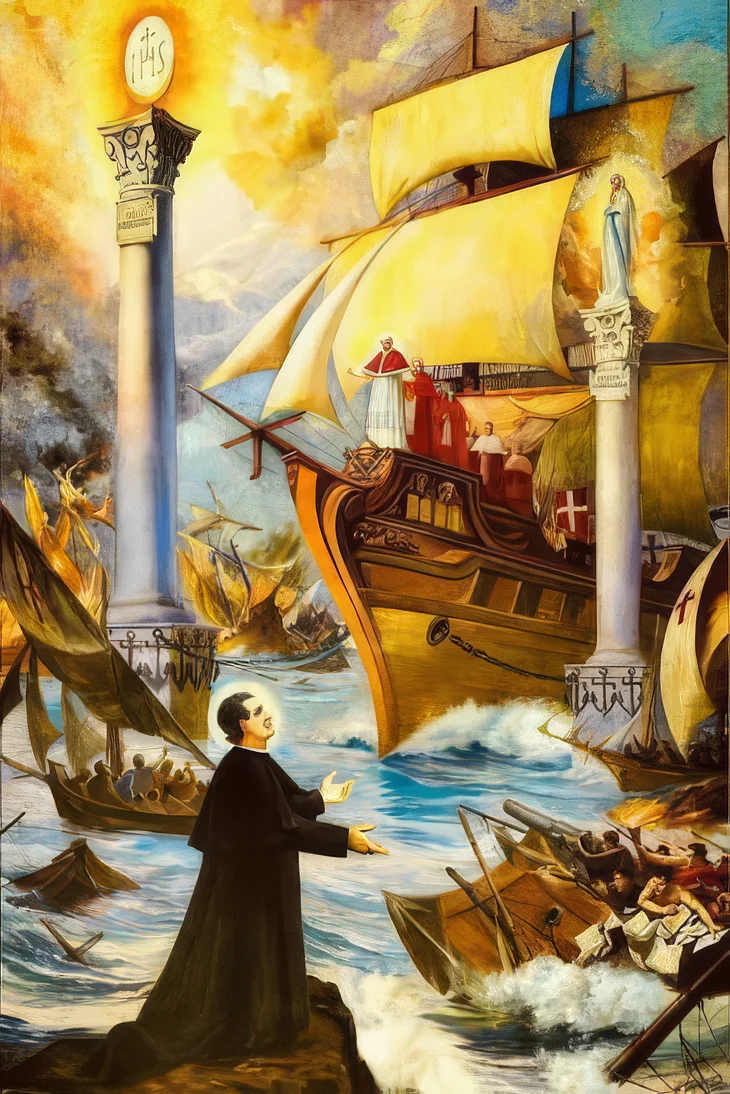
The Eucharistic Rosary Congress also draws inspiration from one of the most famous prophetic visions in Catholic history: St. John Bosco’s Dream of the Two Pillars.
In his dream, Don Bosco saw the Church represented by a great ship sailing through a violent storm while countless enemy ships attacked from every side. The Pope courageously guided the Barque of Peter through the chaos toward two towering pillars rising from the sea. On the taller pillar stood the Blessed Sacrament, bearing the inscription Salus Credentium (“Salvation of the Faithful”). On the second stood the Blessed Virgin Mary, under the title Auxilium Christianorum (“Help of Christians”).
Only when the ship was securely anchored to these two pillars did the storm cease, the enemies scatter, and a great calm descend upon the sea. Don Bosco’s dream has long been understood as a prophetic reminder that the Church finds her strength and safety in Jesus Christ truly present in the Holy Eucharist and in the maternal protection of the Blessed Virgin Mary.
The Eucharistic Rosary Congress is a living expression of this vision. For seven days and nights, the faithful anchor themselves to these same two pillars through perpetual Eucharistic Adoration and the continual prayer of the Holy Rosary. It is a response of faith to the trials of every age, placing complete confidence in Christ present in the Eucharist and in the intercession of His Mother.
A Seven-Day Cenacle of Prayer
Each Eucharistic Rosary Congress consists of:
– Seven days and nights of Perpetual Eucharistic Adoration
– The Holy Rosary is prayed aloud at the beginning of every hour
– Daily Holy Mass, opportunities for Confession, Eucharistic processions, Marian devotions, spiritual conferences, and other parish activities that foster deeper conversion and prayer.
– The Congress becomes a modern-day Cenacle, recalling the Apostles gathered with the Blessed Virgin Mary in prayer before Pentecost. United around Jesus in the Blessed Sacrament and Mary in the Holy Rosary, the faithful ask for a renewed outpouring of the Holy Spirit upon the Church, our nation, and the whole world.
Today, Eucharistic Rosary Congresses continue to be celebrated in parishes and dioceses throughout the United States and around the world. They are a powerful witness that the renewal of the Church begins not with programs or strategies, but with prayer—before the Eucharistic Lord and under the loving mantle of the Blessed Virgin Mary.
As Pope St. John Paul II taught, “The Church draws her life from the Eucharist.” The Eucharistic Rosary Congress invites every Catholic to rediscover that truth by remaining close to the two pillars that have always sustained the Church: the Holy Eucharist and Our Lady.