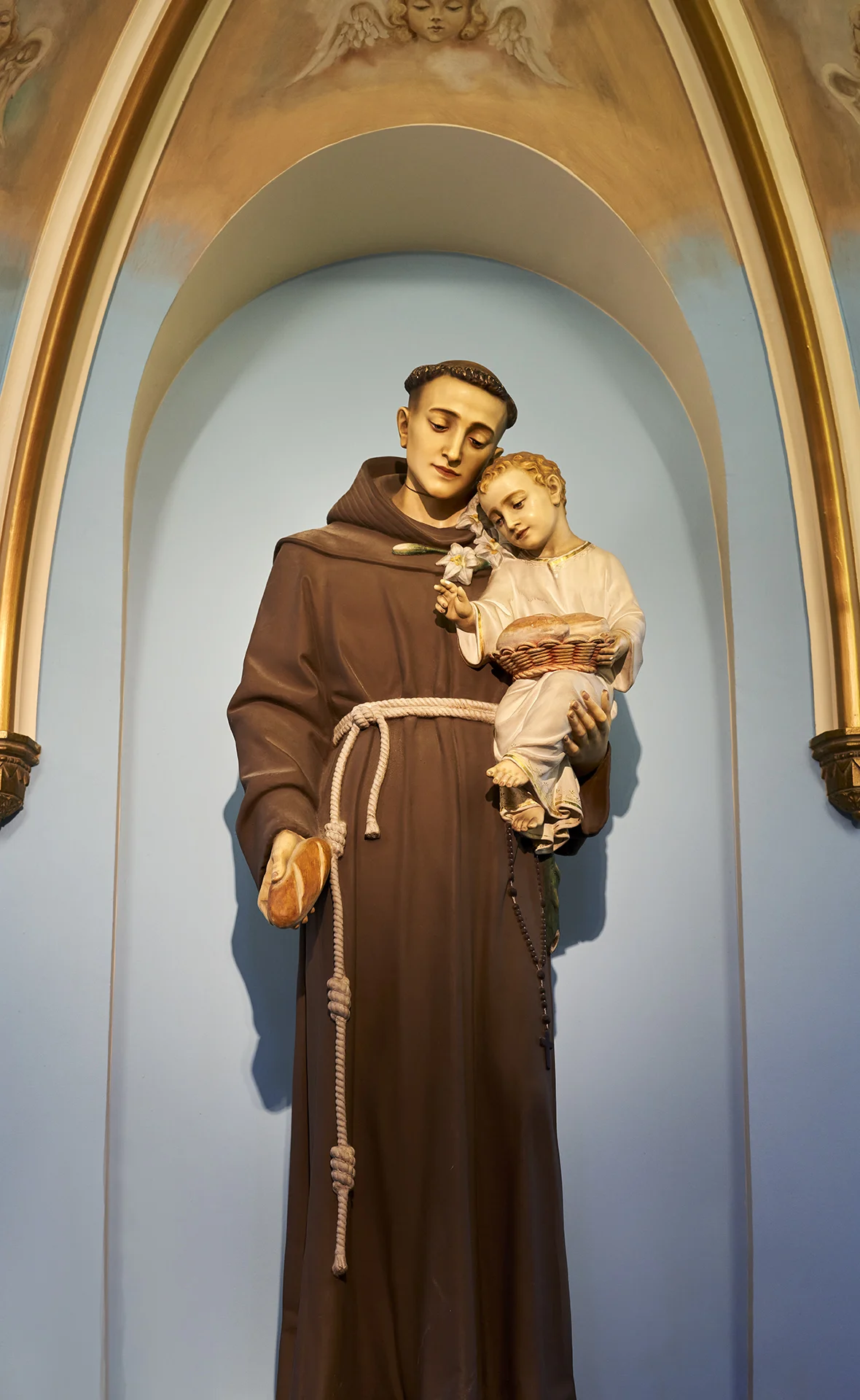
Saint Anthony of Padua (born Fernando Martins de Bulhões in 1195 in Lisbon, Portugal) was a Franciscan friar, priest, and gifted preacher, renowned for his deep knowledge of Sacred Scripture and his compassion for the poor. Inspired by the martyrdom of Franciscan missionaries, he joined the Franciscan Order and devoted his life to preaching throughout Italy and France, calling people to faith, repentance, and charity.
Known for his wisdom and numerous miracles, Saint Anthony died in 1231 and was canonized only one year later. He was later declared a Doctor of the Church for his outstanding theological teaching. Today, he is widely venerated as the patron saint of the poor, sailors and fishermen, priests and travelers, a protector of mail, and a powerful intercessor and wonder-worker. Saint Anthony is often depicted holding the Infant Jesus, standing upon a book that represents his wisdom and mastery of Scripture, and carrying a lily, a symbol of purity. The image of Saint Anthony holding bread refers to the tradition known as Saint Anthony’s Bread, a charitable practice of giving bread or alms to the poor in gratitude for favors received through his intercession. This tradition dates back to a 13th-century miracle in which a mother promised to donate her drowned child’s weight in grain to the poor after Saint Anthony restored the child to life. From this act arose a lasting legacy of generosity and compassion closely associated with this beloved Franciscan saint.
Franciscan Friar: A devoted follower of Saint Francis of Assisi, Saint Anthony embraced a life of poverty, humility, and service to the poor.
Doctor of the Church: Honored for his exceptional teaching and deep understanding of Scripture, he is often called the “Evangelical Doctor.”
Gifted Preacher: His eloquent preaching drew countless people back to the faith and inspired repentance, charity, and devotion to Christ.
Patron Saint: Venerated as the patron of the poor, sailors and fishermen, travelers, priests, lost items, and a protector of mail.
Miracle Worker: Known for many miracles during his life and after his death, Saint Anthony is especially invoked for help in times of need.
Symbols: Commonly depicted with the Infant Jesus, a book, a lily, and bread—each reflecting his wisdom, purity, charity, and close union with Christ.